
Artist Biography
Katherine Kaplafka is an interior designer whose work often explores immersive environments, the emotional experience and comfort. She will be graduating with a BFA in Interior Architecture from Endicott College in Beverly, MA. While at Endicott she has maintained a position on the Dean’s List and has become a member of Kappa Pi International Arts Honor Society. During her internship journey with Endicott she has gained experience in Residential and Hospitality design while working with Goedecke Flooring and Design, NorthPoint Construction, and DAG Design. Her experiences both in the workplace and studying abroad in Florence, Italy and Copenhagen, Denmark, have given insight into the design world. After Graduation, Katherine will be doing a bit more studying while visiting Japan with Endicott. She would like to thank her friends and family, and especially those who have supported her and guided her through the past four years.
Thesis Abstract
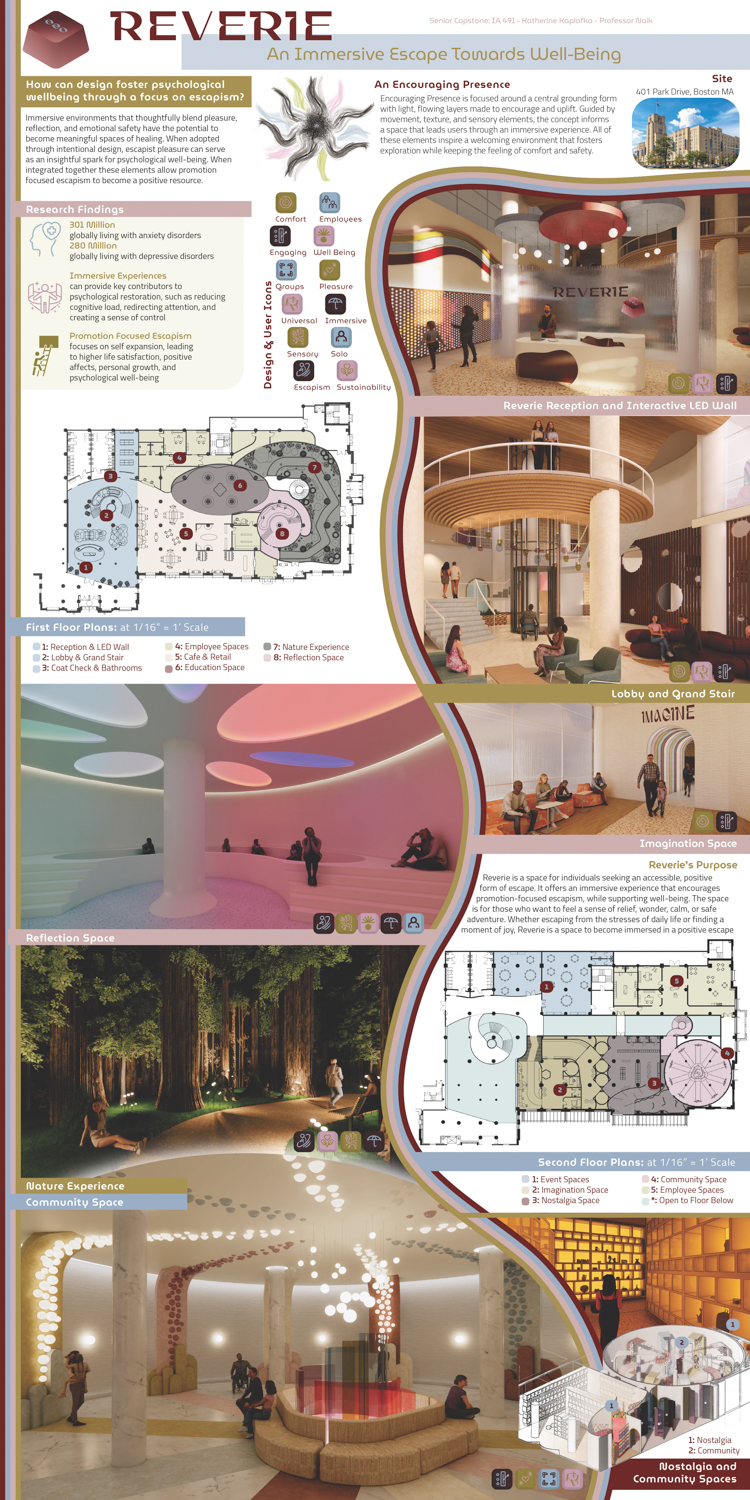
The design of Reverie explores the potential of immersive environments to support psychological well-being through the intentional use of escapism, reflection, emotional safety, and imaginative experience. The project investigates how interior architecture can be more than functional requirements using research on experiential design, cultural psychology, sensory engagement, and emotional safety
The project builds this research into a series of five experiential spaces, each meant to engage a different aspect of emotional and psychological well-being. The Imagination Space prompts creativity and personal expression through interactive spaces that invite visitors to use their imaginations and construct worlds or simply imagine a happy memory. The Nostalgia Space explores the emotional importance of memory and familiarity, through design elements the space is able to evoke comfort, reflection, and personal connection to the past. The Community Space provides a shared experience and fosters connection, conversation, and collective engagement through its participatory elements. The Nature Space highlights restoration through sensory design using natural forms, materiality, and calming conditions within the space that reconnect visitors to nature. Finally, the Reflection Space provides a quieter and more introspective experience, made to support emotional processing, mindfulness, and contemplation.